Hospitals are no longer being asked to trim excess. They are being asked to protect care with fewer cards in the deck.
Scripps Health CEO Chris Van Gorder recently described the financial reality plainly — more than $100 million per year in estimated annual impact from HR 1 alone, with additional exposure from proposed Affordable Care Act cost-sharing reductions, 340B program changes, site-neutral payment expansion, and further Medicaid cuts on the table. Kodiak Solutions estimates the hospital sector could absorb up to $25 billion in annual revenue reductions. For safety-net and rural systems, Commonwealth Fund analysis cited by Becker's suggests operating margins could shrink by nearly 30% under Medicaid coverage-loss scenarios.
And then Van Gorder said something health system leaders across the country already know is true:
There is no excess left to trim without affecting patient care.
That sentence is the strategic condition every hospital CFO, COO, and CNO is operating inside right now. Not as a future concern. As the current reality.
When there is no excess left, every cut becomes structural
Over the past decade, health systems have streamlined operations, reduced administrative overhead, and implemented technology to improve care delivery. The efficiency work has been done. What remains is not waste. What remains is the system itself.
That means the next phase of cost strategy cannot be more of the same. Cutting deeper without knowing where the system can absorb and where it cannot is not efficiency. It is risk redistribution — moving exposure from the budget to the workforce to the patient experience, without making it visible in the process.
The question that matters now is not only: Where can we spend less?
It is: Where are we already losing capacity we did not budget for — and how do we protect what is left?
The hidden cost cascade policy pressure creates
Revenue reductions do not stay in the finance department. They move through the system.
When reimbursement tightens and budgets compress, the cascade typically follows a predictable path:
First, hiring slows. Then, support roles stretch to cover gaps. Then, managers absorb more than their span of control was designed for. Then, teams become harder to stabilize — not because of individual performance, but because the coordination load has exceeded what the structure can sustain. Then, turnover accelerates. Then, agency spend rises to fill the gap. Then, patient experience begins to drift. Then, execution on the very modernization investments designed to generate long-term financial return slows or stalls.
Every step in that cascade carries a cost. But most of it is invisible until after the damage is done.
At a recent Becker's Healthcare webinar on revenue cycle transformation, the CFO of Singing River Health — a community health system in Mississippi — described what that financial pressure looks like from the inside. Every capital planning cycle begins with a wish list roughly three times larger than what the organization can realistically fund. What follows, in his words, is a "Hunger Games" process: competing for every dollar, deferring investments the system genuinely needs, and making sustainability decisions with an incomplete deck.
That kind of capital constraint does not stay inside the finance department. When organizations are forced to fight for every investment dollar, the coordination infrastructure that makes staffing adjustments, change initiatives, and technology adoptions actually land — that infrastructure gets squeezed. As his technology partner noted in the same conversation, healthcare is in a constant state of change, but the change management that protects the people inside that change is almost never adequately resourced.
That gap is where preventable cost forms. Quietly. Between the budget decision and the outcome report.
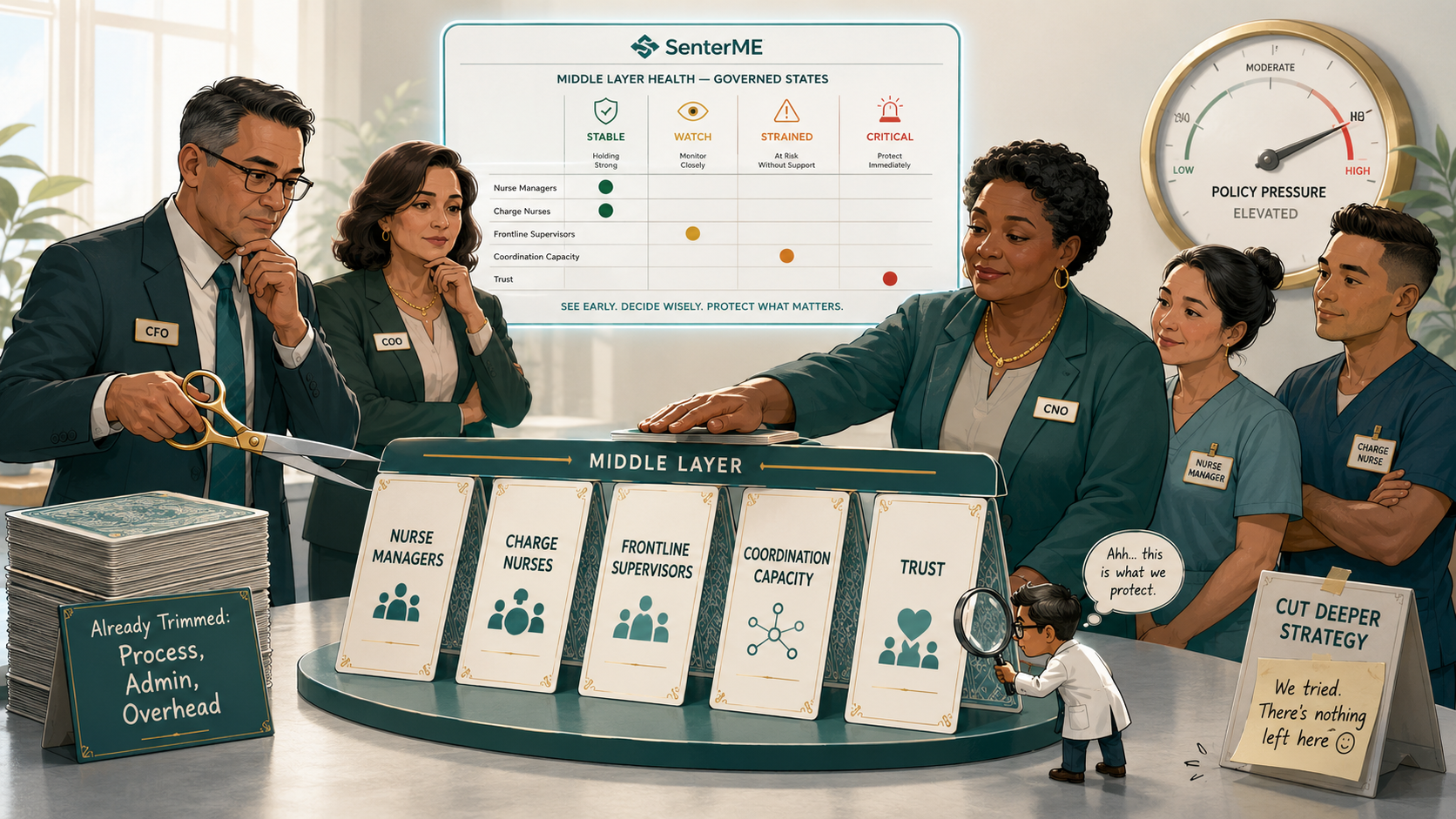
The layer where strain concentrates before it becomes cost
There is a specific place in the health system where financial pressure, operational strain, and workforce stability all intersect before any of it becomes visible in a report.
It is the middle layer.
Nurse managers, charge nurses, and frontline supervisors are the coordination infrastructure of the health system. They translate staffing plans into daily reality. They absorb scheduling gaps, manage team morale through vacancy periods, hold communication together during change initiatives, and protect patient care while the organization works through whatever the current crisis is. They are the layer where revenue pressure becomes workload, where workforce strain becomes turnover risk, and where institutional stability is either protected or slowly eroded.
When the middle layer has adequate capacity and visible support, the system holds. When that layer is silently overloaded — carrying pressure no dashboard is tracking — the costs appear later, in ways that feel sudden but were forming for months.
For the CNO, this is where the financial problem becomes a clinical leadership problem: the system cannot protect safe, consistent care if the people translating staffing plans into reality are carrying more than the structure can absorb.
That is the layer SenterME is built to see.
What earlier visibility makes possible — and what it cannot do
SenterME is not a policy solution. We will not say that partnering with us offsets Medicaid reimbursement cuts, reverses the impact of HR 1, or guarantees savings against federal funding reductions.
What we can say, with precision, is this:
The secondary cost cascade that policy pressure creates — the turnover, agency dependency, execution delay, and care disruption that follows revenue contraction — is not always unavoidable. Some of it is preventable. But preventing it requires seeing it while the outcome is still movable.
SenterME's Structural Health Intelligence™ platform surfaces four governed states — Stable, Watch, Strained, and Critical — across the middle layer, in real time, before the strain becomes visible in HRIS data, exit interviews, or the annual retention report.
That earlier visibility supports more precise decisions: where to protect staffing first when budgets require prioritization; where strain is concentrating before it becomes a turnover cluster; where support is working — so it is not cut; which units carry the most preventable exposure, and which are more stable than the data currently suggests; where a leadership intervention has a real chance of changing the trajectory before outcomes become irreversible.
What health systems need to protect is not only headcount. It is the coordination capacity that keeps staffing plans workable, the manager capacity that keeps teams stable, and the trust infrastructure that allows leaders to hear the truth before the cost appears. When those elements are visible, the decisions around them become more precise. When they are invisible, the first signal is often the cost that confirms something has already been lost.
This is not a promise to save $25 billion. It is a partner posture that takes the financial reality seriously and offers a contained, defined entry point designed to reveal whether preventable exposure exists before a larger commitment is made.
How SenterME is designed for a constrained operating environment
We are aware that every new spend decision inside a health system right now requires justification against a very different baseline than two years ago. The 90-Day Structural Health Intelligence™ Diagnostic was designed with that reality in mind.
At the same Becker's Healthcare webinar, the Singing River CFO described what he ultimately looked for in a technology partner: realistic goals, transparency about current capabilities and a clear roadmap, and a demonstrated track record of under-promising and over-delivering in an environment full of vendors who do the opposite. ROI clarity and trust — not feature sets — determined the decision. That is the posture SenterME is designed to hold.
The diagnostic starts at $25,000. It is bounded in scope, moderate in organizational lift, produces defined readouts, and requires no PHI, no individual employee identification, and no new surveillance infrastructure. It is designed to answer one operational question before a health system commits to anything larger:
Does preventable workforce exposure currently exist that your leadership cannot see — and would earlier visibility change any decisions you are making right now about staffing, investment, or cost structure?
If the answer is no, that is valuable information. If the answer is yes, the diagnostic surfaces where, in what form, and at what potential scale.
The broader partnership path is intentionally staged: diagnostic first, expansion only when the evidence supports it, and enterprise deployment when the system can justify continuous structural visibility as part of its operating infrastructure.
The argument is not: add SenterME to the budget.
The argument is: if you are already spending on engagement tools, pulse surveys, and retention programs that are not producing structural clarity, those dollars may be funding the wrong layer. SenterME is designed to consolidate fragmented workforce measurement, engagement, and support spend into a single structural intelligence investment — one that produces executive-level visibility, compliance documentation support, and continuous workforce sensing.
The next era of hospital efficiency
The efficiency work of the last decade focused on process and administration. That work mattered and much of it is complete.
The efficiency opportunity of the next era is different. It is about knowing what is forming inside the system before it becomes a cost — and making more precise decisions about where to protect, where to intervene, and what not to cut.
Health systems that build earlier visibility into where workforce strain concentrates will not be immune to policy pressure. But they will be less likely to absorb it blindly. They will have more time to act. More evidence to inform the decision. More precision in what they protect and what they adjust.
That is not a platform selling point. It is what structural intelligence is for.
If your health system is reassessing cost structure, workforce stability, and where to protect capacity — that is exactly the conversation SenterME was built for.
External references: Becker's Hospital Review, "Scripps CEO: Hospitals running out of ways to cut costs," April 2026; Kodiak Solutions hospital revenue impact estimates; Commonwealth Fund, "Impact of Medicaid Work Requirements on Hospital Revenues and Margins," 2025; Becker's Healthcare Webinar, revenue cycle transformation panel featuring Singing River Health, May 2026.