I did not come into healthcare as a nurse, a hospital operator, or a clinical executive.
I came into this work as a systems thinker, an investment advisor by background, and someone with more than twenty years of experience in sales, systems design, and building around patterns that most people feel long before they can name. I am still learning how to be the kind of partner I want to be for health systems. I say that openly because trust matters more to me than pretending expertise I have not lived.
What I do have is a deep respect for the workforce that holds healthcare together, and a very personal understanding of what strained health systems feel like from the outside looking in. I have experienced healthcare as a patient, as a mother of a patient, as a sister of a patient, and as a daughter of a patient. I know what it feels like when the system is trying to hold itself together while the people inside it are carrying too much.
That is part of what led me here.
The other part is that I kept coming back to one question:
What makes burnout feel inevitable inside some systems, even when the people inside them are deeply committed, highly capable, and still trying their best?
That question led me to what I now call Structural Health Intelligence™.
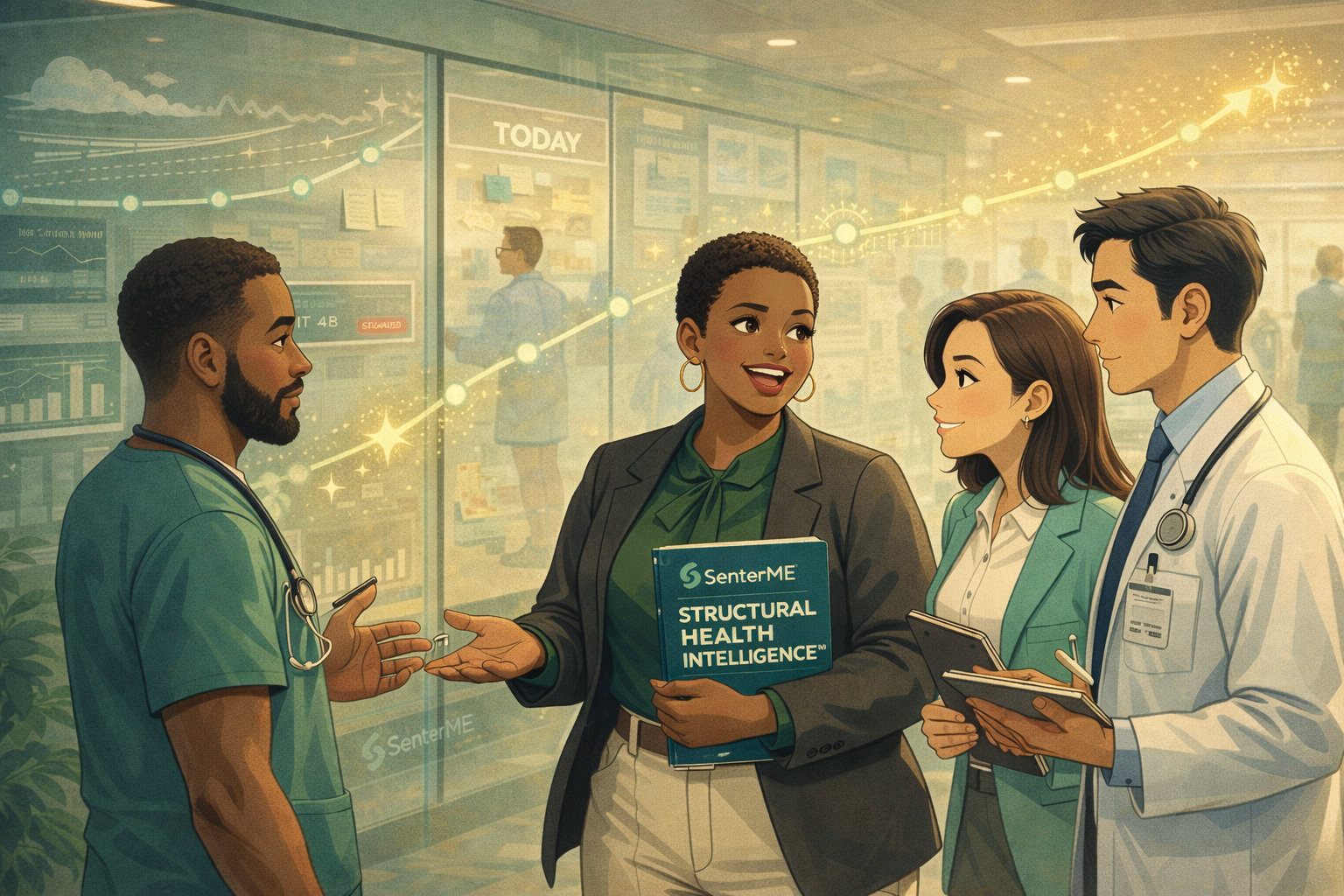
Structural Health Intelligence™ is a simple idea with serious implications. It is the ability to see, in real time, how an organization's teams are actually holding up before the damage shows up in turnover, care disruption, failed initiatives, or compliance risk. In plain terms, it asks a different question than most workforce tools ask. Not "How satisfied are people?" after the fact, but:
"Where is pressure building now, and what is that pressure likely to cost if no one can see it early enough to act?"
As I kept listening to healthcare leaders, a pattern became impossible to ignore. The point of greatest vulnerability was often not the executive suite and not the frontline alone. It was the people in the middle: nurse managers, charge nurses, team leaders, and others carrying the responsibility of translating strategy into reality while absorbing pressure from both directions.
Again and again, the same operational patterns surfaced. Leaders told us they had access to plenty of data, but not the kind that helped them lead. They described communication failures during change, teams that looked staffed on paper but felt short in practice, and middle managers carrying unsustainable loads while the organization's commitment to world-class patient care still required flawless execution.
A few moments from customer discovery have stayed with me: "We have access to so much data, but so little information." Another: "I wish there was a rapid response alert for the workforce." Those are not software requests. They are signals of a system-level blind spot.
That blind spot matters even more now because healthcare's accountability environment has changed.
What makes this moment different is not that hospitals suddenly have a brand-new compliance obligation that never existed before. It is that staffing oversight, nursing-services accountability, quality performance, and documented outcomes are becoming harder to separate from one another.
Effective January 1, 2026, The Joint Commission replaced the hospital National Patient Safety Goals chapter with National Performance Goals, including NPG 12 on Health Professional Resource Management. Joint Commission describes the new chapter as organizing existing requirements into 14 measurable topics, with staffing and clinical team planning more visibly tied to quality and safety.
That matters because hospitals are already accountable for maintaining organized nursing services with adequate staffing and registered-nurse oversight under CMS Conditions of Participation. Under 42 CFR §482.23, hospitals must maintain an organized nursing service, provide 24-hour nursing services, and have adequate numbers of nursing personnel to provide care as needed. At the same time, CMS's Hospital Value-Based Purchasing Program continues to adjust IPPS payments based on quality performance, and Magnet recognition continues to emphasize leadership, structural empowerment, and empirical outcomes.
What I believe healthcare still lacks is not more reporting after the fact, but earlier visibility into the workforce conditions that shape whether staffing plans hold, whether middle management can absorb pressure, and whether intervention is still possible before downstream damage becomes expensive or public. That is where I believe Structural Health Intelligence fits — a practical way to strengthen leadership oversight, staffing review, performance-improvement analysis, and internal documentation in areas hospitals are already being held accountable for.
That is why this moment feels so important to me.
In March 2026, we shipped v1 of Santi, SenterME's Signal-to-Strategy Engine. Around the same time, the market was getting louder in a different way. Not just through founder intuition, but through customer validation, regulatory alignment, and executive traction.
Our discovery work kept pointing to the same reality: leaders do not need more lagging surveys. They need earlier visibility. They need to know where support is thinning, where communication is breaking down, where middle management is absorbing too much, and where intervention is still possible before a problem becomes expensive, clinical, or public.
Our internal framing became clearer too. This is not a wellness app story. It is not an engagement dashboard story. It is not a softer culture story. It is infrastructure for seeing what hospitals are increasingly being held accountable for. U.S. hospitals carry billions in preventable exposure because the workforce conditions that shape staffing stability, execution quality, and patient experience remain invisible until damage is already underway.
That is the gap we built toward.
And the market has been validating that direction in multiple ways. Health system leaders have told us the problem is real. We received approval from a system CNO at a top-30 U.S. health system. And SenterME's 90-Day Structural Health Intelligence™ Diagnostic is designed as a bounded period for a health system to test whether earlier, aggregate visibility into workforce strain gives leadership a more credible basis for seeing where pressure is concentrating, how it is behaving over time, and where deeper review or action may be warranted.
This helps health systems build stronger oversight and decision support in a regulatory and operational environment that is clearly demanding more disciplined staffing governance than lagging tools alone can provide.
Here is my full-circle moment.
I started with a human question: what makes burnout feel inevitable?
What I found was not a single bad leader, not a weak workforce, and not a lack of caring. I found a visibility problem. I found that many of the people responsible for protecting care, staffing, and execution are being asked to lead systems they can only partially see. And now, increasingly, they are being asked to prove that their decisions are responsive, evidence-based, and safe in real time.
That is why I believe Structural Health Intelligence™ is its own category.
Because there is a difference between measuring morale and measuring whether a system is holding.
There is a difference between knowing people are tired and knowing where pressure is concentrating, whether it is spreading, and whether leadership still has an intervention window.
And there is a difference between supporting patient care as a value and building the operational and compliance infrastructure that helps protect it over time.
That is the work I am committed to.
Not as someone claiming to know everything about healthcare.
But as someone willing to learn in public, build responsibly, listen closely, and keep aligning the product to what health systems are actually being asked to carry.
If you are a hospital or health system leader trying to protect patient care while strengthening the workforce conditions underneath it, this is the conversation I believe matters now:
How are you currently seeing the pressure building before it becomes turnover, disruption, or risk?
And if the honest answer is that you are still being forced to find out too late, that is exactly why we built SenterME.
We are currently identifying the first cohort of health systems for our 90-Day Structural Health Intelligence™ Diagnostic.