Health systems are not short on workforce and operational tools. Engagement and sentiment platforms capture how people report feeling. Org design and workforce systems show staffing structure, roles, spans, and labor configuration. Operations and throughput tools surface flow, utilization, bottlenecks, and efficiency gaps.
Each category is essential. Each sees part of the system. But none was built to detect the same thing: unmanaged structural strain forming inside the middle layer of nurse managers, charge nurses, and frontline supervisors before the lagging indicators move.
Engagement tools may capture sentiment after the moment has passed. Workforce systems may show the role without the lived load. Throughput tools may show where performance slows without explaining the coordination strain underneath it.
Leaders already feel this gap. As one chief nursing officer told us: "We have access to so much data, but so little information." The dashboards are full; the early signal is missing.
That is the blind spot SenterME was built to close. It surfaces early structural risk patterns across organizational layers, continuously and in real time, from protected human signals.
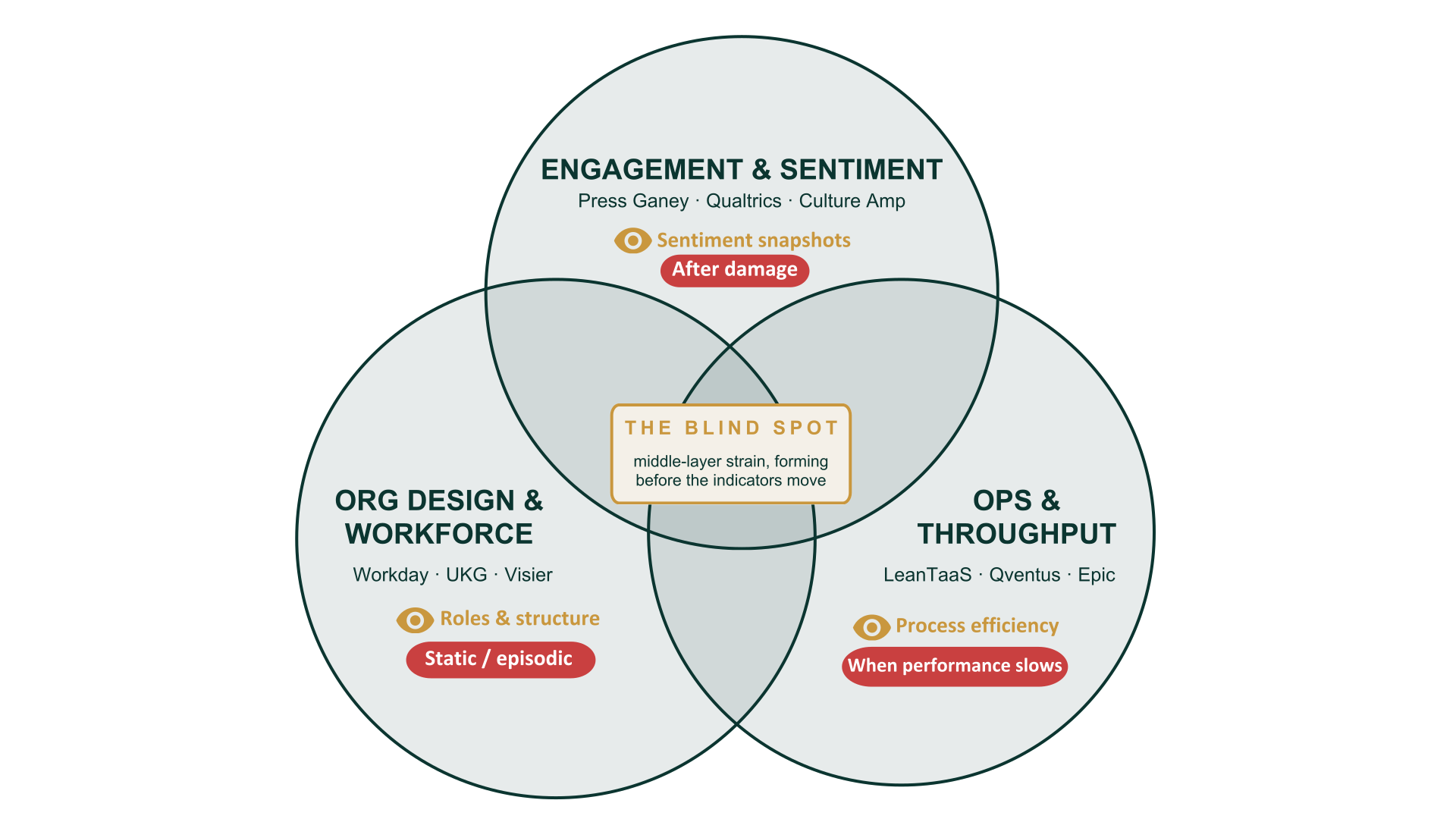
To see what that blind spot looks like with a person standing inside it, consider Olivia.
Inside the blind spot
Olivia is a labor and delivery nurse manager. Ten years in, respected by her team, trusted by leadership. On paper, she is holding the unit together: staffing is covered, the dashboards are not flashing red, the work is getting done.
This morning, before any of that, she was on her knees at 6 a.m. scraping a fistful of Vaseline out of the living room carpet, because her two-year-old has discovered that jars open, and that everything inside them belongs on the floor. She got him to daycare. She got herself to work. She has not stopped moving since.
By the time she reaches the floor, she is covering two vacancies, absorbing another workflow change, answering questions from newer nurses, and keeping morale steady on a unit that has felt heavier than it did six months ago.
A sentiment survey may not register this until the next cycle. A workforce system sees her role, not her load. A throughput dashboard sees her unit's numbers, not the coordination strain behind them. Olivia is standing exactly where none of the existing tools are looking.
We do not claim to know what Olivia needs in a moment like that. What we believe is simpler: that she deserves a moment that sees her, before her experience ever becomes useful to anyone else. The methodology begins there.
Where SenterME started
We did not start as an analytics company. We started with a wellness experience, and we learned what many operators already understood: helping the individual matters, but the organization also needs a way to understand what those human moments reveal structurally.
Many organizations had made the same sincere bet: meditation apps, resilience workshops, wellbeing subscriptions. These were not careless choices; they were honest attempts to support people inside a system that keeps getting harder to sustain. The difficulty was defending them. In a 2024 study published in the Industrial Relations Journal, University of Oxford researcher William J. Fleming compared workers who used common individual-level wellbeing programs with those who did not, and found no evidence that participants were better off across multiple wellbeing measures. That finding does not mean individual support has no value; it points to the limits of treating individual-level support as the whole enterprise answer. Behavioral scientists Nick Chater and George Loewenstein describe a related distinction as the difference between the i-frame and the s-frame: approaching a problem at the level of the individual versus the level of the system.
So the question became more precise: what if a private moment of support could stay genuinely private for the person, while still contributing to an anonymized, aggregated signal the organization could use responsibly? The value was never going to come from proving one moment made one person feel better. It would come from responsibly translating many protected moments into visibility leaders could act on.
We had been studying a pattern we have named Enterprise Collapse Disorder: the progressive loss of an organization's ability to sense its own internal strain early enough to act. Seen that way, the individual was never the only patient. The organization had a condition too, and an executive's accountability is the whole organization, not any one person inside it.
That reframe is the foundation of SenterME. The protected individual experience makes the human moment safe and valuable; Santi, our signal-to-strategy engine, is the structural translation layer, the system-level frame the market has been missing. One without the other is either support leaders struggle to defend or a dashboard no one should trust. The individual moment has to come first, because if people do not believe it is safe, the signal underneath it is meaningless.
This is built for whole people, not job titles. You may see a nurse or a clinician in the imagery, but that is representation, not definition. The experience does not assume Olivia's stress is a nursing problem, or that anyone's stress belongs to their role, which is exactly why it can hold the strain that started on a living room floor at 6 a.m. and walked into the unit a few hours later.
From one private moment to structural visibility
Here is the journey, start to finish.
Moment. Olivia opens the app for under a minute. It asks her to name what she is feeling and how much she is carrying.
Exchange. In return, she chooses what might help her: a short reflection, a guided reset, a moment of affirmation, a piece of audio, a community thread where she reads that she is not the only one, or simply language to name what she is carrying. We do not decide which of those is right. She does. And in choosing something for herself, she offers something we can read structurally. That is the principle underneath all of it: exchange, not extraction.
Protection. Before signals are interpreted structurally, identifying information is removed from the pattern Santi reads. Santi is designed to work from anonymized, aggregated signal movement rather than individual identity. Leadership does not receive individual-level check-ins; it receives structural patterns only when those patterns meet the system's aggregation and governance rules.
Pattern. One moment proves nothing. But repeated, voluntary, aggregate moments across a role group or unit begin to reveal movement over time, whether strain is forming, concentrating, or easing, rather than on a single hard Monday.
State. Santi maps that movement to one of four governed states: Stable, Watch, Strained, Critical. Because each signal is tracked by role, the middle layer Olivia leads in becomes visible on its own, without exposing anyone in it.
Timing. For each unit, the leader sees whether the intervention window is opening, widening, narrowing, or closing: whether there is still room to act before a pattern hardens.
The point of the chain is the last link. The CNO never sees Olivia. She sees that a unit she trusted is quietly drifting from Watch toward Strained, and that the window to do something is still open. It began with one moment Olivia was allowed to have to herself.
What our live deployment taught us
Between December 2024 and February 2025, we ran a 90-day live deployment. It was small on purpose. Roughly 80 participants generated more than 200 stress and emotional-state signals. We were not chasing an impressive number. We were testing one question: would people come back on their own?
They did. Before we turned on a single notification, participants returned voluntarily, about once or twice a week. And they did not return at random: engagement appeared to cluster around end-of-week and start-of-week rhythms rather than a scheduled prompt.
That is not proof of an outcome. It is proof of a method: the exchange worked, and even modest voluntary participation produced enough signal density to show how strain and recovery actually behave.
What operators told us they need
Across our discovery conversations with more than 160 frontline workers, middle managers, and healthcare executives, the same realities kept surfacing:
"I wish there was a rapid response alert for the workforce."
"We're rounding, but nothing actually changes."
"No trust, no progress."
Read together, they describe a single gap. Leaders are not short on dashboards; they are short on the thing that tells them where to look and when. They do not want names. They do not want surveillance. They want early, consolidated, trustworthy visibility, and a loop that turns a signal into an action instead of another report that disappears.
That is the difference between measuring people and seeing a system.
The methodology, in one line
Support first. Protect by design. Interpret structurally.
By the time you have followed Olivia from a jar of Vaseline to a structural state, those three lines are not a slogan. They describe what happened: a private moment, kept safe, that a person chose for herself, and that, in time, gave a leader something the existing tools never could.
Olivia is an illustrative composite drawn from SenterME's discovery interviews, not a real individual.
Sources
- William J. Fleming, "Employee well-being outcomes from individual-level mental health interventions: Cross-sectional evidence from the United Kingdom," Industrial Relations Journal (2024).
- Nick Chater and George Loewenstein, "The i-frame and the s-frame: How focusing on individual-level solutions has led behavioral public policy astray," Behavioral and Brain Sciences (2023).
- SenterME customer discovery (160+ interviews) and the December 2024–February 2025 live deployment.
- Press Ganey, Qualtrics, Culture Amp, Workday, UKG, Visier, LeanTaaS, Qventus, and Epic appear in the accompanying diagram as illustrative, widely used examples of their respective categories; all marks belong to their owners, and no affiliation or endorsement is implied.